
From SCAMP to the Future: How Integrated Ammunition Manufacturing Is Evolving
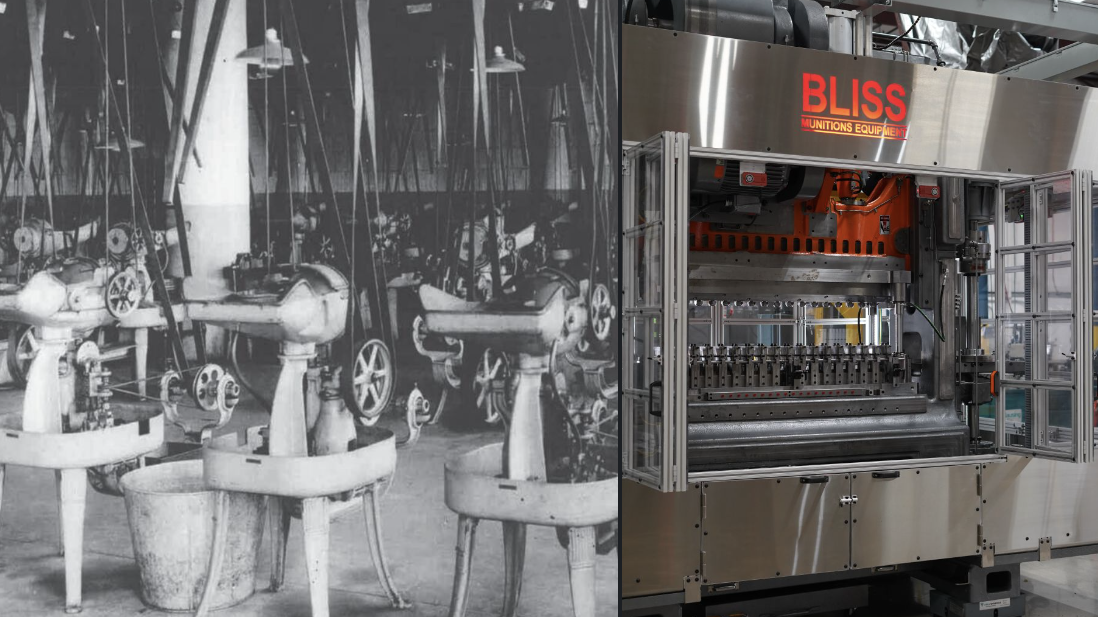
The Small Caliber Ammunition Modernization Project (SCAMP) remains one of the most ambitious demonstrations of what fully integrated ammunition manufacturing could achieve. Decades later, its influence is still felt across the defense industrial base, not as a relic of the past, but as a blueprint.
At Bliss, we don’t view SCAMP as a closed chapter. We view it as a foundation. Today, Bliss is engineering what integrated ammunition manufacturing can do next.
What SCAMP Really Was: An Integrated Transfer Press System at Scale
SCAMP is often described simply as an automated ammunition production line. While true, that description undersells its technical significance. At its core, SCAMP functioned much like a highly specialized, synchronized transfer press system: one designed specifically for small caliber ammunition and executed at a scale few modern engineers will ever encounter.
Rather than isolated machines performing discrete tasks, SCAMP integrated forming operations into a single, coordinated manufacturing ecosystem, where every motion, stroke, and transfer was mechanically synchronized. At the heart of SCAMP were:
- High-speed transfer mechanisms moving cups and cases through sequential forming stations without manual intervention.
- Multi-stage cupping, drawing, heading, and trimming operations arranged as an extended transfer press architecture.
- Continuous material feeds supplying each press and operation.
- Mechanical timing systems synchronizing dozens of processes at fixed strokes per minute, directly determining output volume.
In practical terms, SCAMP wasn’t just a “line.” It was a distributed transfer press, capable of producing tens of thousands of cases with highly repeatable geometry by treating ammunition manufacturing as a single, synchronized process rather than a series of standalone steps.
The Limitations of SCAMP in a Modern Context
For all its innovation, SCAMP was a product of its time. But its architecture introduced several constraints that limit its applicability in today’s defense manufacturing environment:
- Extremely large floorspace requirements
- Lower throughput by modern standards
- Fixed stroke rates, limiting flexibility across calibers
- High mechanical complexity spread across multiple machines
- Limited ability to adapt quickly to changing production requirements
As defense demand has shifted toward higher annual volumes, faster scalability, and greater flexibility, these limitations have become more pronounced. The principles were sound, but the execution by today’s standards needed evolution.
Bliss’s Approach: Compressing SCAMP’s Principles Into Modern Transfer Press Technology
Bliss has taken the fundamental engineering logic behind SCAMP and reimagined it for modern ammunition production. Rather than spreading integrated operations across massive, fixed systems, Bliss compresses those same principles into singular, high-performance machines, each designed to function as part of a smaller-footprint, modular production line. What’s changed:
- Integrated transfer press architectures housed within individual machines
- Variable stroke rates, adjustable by caliber and production requirements
- Dramatically reduced floorspace
- Production capacities measured in the millions per year
- Modern sensors, diagnostics, and analytics, combined with reliability standards aligned to today’s long-life manufacturing expectations
In effect, Bliss has eliminated SCAMP’s constraints while preserving and enhancing its core advantage: synchronized, repeatable, and high-output.
From Fixed Systems to Flexible Production
One of the most significant advancements over SCAMP-era manufacturing is flexibility. Where SCAMP relied on fixed stroke rates and rigid sequencing, modern Bliss transfer presses and bullet assembly machines allow manufacturers to:
- Adjust stroke rates based on caliber
- Optimize throughput without sacrificing geometry
- Integrate seamlessly with upstream and downstream processes
- Modernize or expand production incrementally rather than all at once
This flexibility is critical in today’s environment, where ammunition manufacturers must respond to changing defense requirements, evolving standards, and fluctuating demand.
The Modern Evolution of Integrated Ammunition Manufacturing
In many ways, today’s Bliss solutions represent the natural evolution of what SCAMP set out to achieve:
- A precise, high-output production system
- Designed and built around integrated forming rather than isolated operations
- Engineered with modern reliability, maintainability, and lifecycle support in mind
- Delivered from a single source with end-to-end system accountability
What once required massive facilities and fixed mechanical timing can now be achieved through compact, adaptable, and highly efficient transfer press technology.
Looking Ahead
SCAMP proved what integrated manufacturing could do. Bliss is engineering what it can do next: bringing the same foundational principles forward with modern engineering, scalability, and performance expectations.
To learn more about our transfer presses/bullet assembly machines designed for modern manufacturing, explore our solutions here.